- Mar 11 Thu 2010 04:12
-
[剪報] Wired- Your Computer Really Is a Part of You
- Jun 25 Thu 2009 23:11
-
98年外交新聞、調查、國安、原住民族特考自6月19日起受理報名
98年公務人員特種考試外交領事人員及國際新聞人員考試、
98年公務人員特種考試法務部調查局調查人員考試、
98年公務人員特種考試國家安全局國家安全情報人員考試、
98年公務人員特種考試原住民族考試定於本(98)年9月26日至28日舉行,
其中外交新聞、調查、國安特考設北部(臺北)考區,
原住民族特考設北部(臺北)、中部(南投)、南部(屏東)、東部(花蓮)及東部(臺東)等5考區,
並自6月19日至7月2日受理報名。
- Mar 05 Thu 2009 21:53
-
[剪報] Three Books...Of Swords And Sorcerers: Books For Magical Escape

Three Books...Of Swords And Sorcerers: Books For Magical Escape
by Mark Barrowcliffe
from the NPR.com
- Mar 04 Wed 2009 14:35
-
[剪報] 227 & 228 聯合報名人堂

2009.02.27 03:56 am |
或許我們只聽說過「非法盜版」這個辭彙,難道也有所謂「合法盜版」這檔事嗎?
- Feb 24 Sat 2007 01:53
-
NYT-Sunday Book Review: 'The Lost Painting': The Caravaggio Trail
Historians take windows where they can find them, and in certain circles this entry from a 17th-century ledger bears particularly vivid witness: On Jan. 2, 1603, a Roman nobleman named Ciriaco Mattei paid 125 scudi - the liras of the day - for what his bookkeeper described as "a painting with its frame of Christ taken in the garden." The artist in question, Michelangelo Merisi, known to most of us as Caravaggio (after his hometown outside Milan), was then among the most famous, innovative and copied painters in Rome - the Picasso of his day, more or less. But tastes change, and the realism that was bracing and revelatory to his contemporaries left a bad odor in the 18th and 19th centuries. By the turn of the last one Caravaggio had become but a footnote in art history. And so, another window: on April 16, 1921, according to the notation on a catalog from a now defunct auction house, "The Taking of Christ," misattributed at the time to a minor Dutch painter, was sold at auction in Edinburgh, for a mere eight guineas, a silk purse pawned off as a pig's ear.
- Sep 29 Fri 2006 22:58
-
美國詩人佛洛斯特未發表詩篇現世
(課本筆記除外……)
可能是一時的心得或想對作者說的話,甚至是靈感?
有些人可能認為這是對書本,對作者是一種不敬,
就像清朝某皇帝每看一次畫就要蓋上印章或寫上心得,
把好好的一幅畫給"破壞"殆盡…。
我自已是認為,是可以寫,但別太過份就好了。
就當作是和文中的作者或人物在交談。
而且紀錄下來的是當時的心情,每次重看時再看看以前所寫的,也滿有趣的。
不過,的確還是有文人自已本身就會在書頁邊緣寫寫東西。
羅伯˙佛洛斯特就是如此。
"Two roads diverged in a wood, and I-
I took the one less traveled by,
And that has made all the difference."
-Robert Frost "The Road Not Taken"
佛洛斯特最出名的詩句之一,相信台灣讀者都不會對這首詩太陌生。
各大高中英文課本,不論版本,幾乎都有收錄這一首。
而前幾年,曾有某位名政治人物在放棄某職位時,
在記者會中引用過這句話,在當時成了各大報的頭版標題。
(那人是誰? 不記得了~)
有點偏正題了。回來主題。
前兩天就在文學重鎮,維吉尼亞大學
一名研究生在圖書館內一箱未分類書籍中,發現佛洛斯特未曾出版的詩,
就是詩人寫在自己已出版的第二部詩集-波士頓的北方 (North of Boston)
內頁中的空白邊緣上。
嗯,既然有大文人都這樣作,那安心寫吧~
- May 01 Mon 2006 06:54
-
NYTimes-Theater Review:Big Love
By BRUCE WEBER
Published: December 4, 2001, Tuesday
It takes a certain gall to write about love these days, not merely as an element of a story but as a serious subject. For one thing, there's the challenge of being articulate and interesting, not to mention original, in an arena where everyone claims experience if not expertise and where so much familiar wisdom is so often repeated that it often feels as though nothing is left to say. For another thing, in the idiom of contemporary storytelling, love is rather a mundane issue, the lightweight stuff of resolvable conflict.
But here is the playwright Charles L. Mee with the forthright assertion that love is all there is. In ''First Love,'' presented earlier this fall at the New York Theater Workshop, he told the story of a man and woman, both in their 70's, who fall for each other passionately and for both good and ill subvert their long-established solo lives.
And now with the concurrent appearance of two other plays -- ''True Love,'' the inaugural production at a new Off Broadway house, the Zipper Theater (336 West 37th Street), and ''Big Love,'' a 2000 work having its New York premiere at the Harvey Theater of the Brooklyn Academy of Music through Sunday -- Mr. Mee has completed his argument that in its various forms love is so consuming that it is fully capable of providing the motivations and upheavals that generate history.
Mostly but not entirely the plays are about sexual love, and each contends, quite literally, that the battle of the sexes is to the death. That's one of the things that makes both ''True Love'' and ''Big Love'' more engaging than ''First Love,'' which succumbs in the end to sentimentality and in any case doesn't carry the brawny conviction of the others.
But beyond that both of the current plays are written with a grand sense of theatricality. And though Mr. Mee has written several riveting monologues for the two plays on subjects like the differences between men and women, monogamy, sexual fetishism and the overlap of passion and fury, both are being thrillingly presented in productions that are far more articulate than the scripts alone can be. As scripts ''Big Love'' and ''True Love'' share so many elements -- a winking, if more than merely passing, reliance on the Greeks; a sense that the mysteries of desire are maddeningly insoluble; the inclusion of popular songs; gooey thrown desserts; and even a few speeches that are close to word-for-word repetitions -- that they might be considered two drafts of the same play or perhaps more accurately two theatrical essays on the same theme.
''Big Love,'' which was first presented at the Humana Festival for New American Plays in Louisville, Ky., is Mr. Mee's cheeky updating of a work by Aeschylus, ''The Suppliant Women,'' in which 50 sisters promised in marriage to their 50 cousins make an angry pact to murder their husbands on their wedding night.
Mr. Mee sets the action at an Italian estate, rendered with exquisite suggestion by the designer Annie Smart with three panels of a clouded blue sky suspended behind a pink wrestling mat that serves as the stage floor. A luxurious bathtub sits on the mat, and above it hangs a chandelier; further toward the audience a beautifully articulated tree branch is suspended, and it casts delicate shadows on the sky panels. It is to this place that the promised brides in their wedding gowns have escaped across the sea from Greece and where they have been taken in by a wealthy family, whose members include Bella, the somber matriarch; Piero, one of her sons, a businessman; and Giuliano, Piero's gay nephew.
Three women -- the sweet-tempered and open-minded Lydia (Carolyn Baeumler); the fervently, almost militantly girlish and princesslike Olympia (Aimée Guillot); and the angrily unforgiving Thyona (K. J. Sanchez) -- represent the 50 brides. And three men -- the stammering, love-struck Nikos (Bruce McKenzie); the insistently macho Constantine (Mark Zeisler); and Oed (J. Matthew Jenkins), a go-with-the-flow sort of guy -- represent their 50 fiancés, who shortly after the play begins arrive by helicopter (wearing flight suits over their tuxes) to reclaim them.
Mr. Mee's script is an amalgam of sometimes brilliant exegeses of sexual roles and predilections and sometimes cute or easy humor that too often employs surprise anachronisms. (Giuliano waxes poetic over his collection of Ken and Barbie dolls, for example.) But as staged by the director Les Waters and the choreographer Jean Isaacs, the inner turbulence in each character raised by love and lust is made so explicitly manifest as to be breathtaking. In addition to delivering shrewd performances that make each of the six betrothed characters distinct, the actors are athletes. Each trio has its own gymnastic sequence in which they tumble over one another and hurl themselves bruisingly to the floor: hence the mat.
These are beautiful and exciting scenes, far more emotionally articulate than the shouting that accompanies them. When one of the men flings heavy circular saw blades into a panel of corkboard, it is stage violence with an astonishingly visceral effect. And in the climactic wedding night scene, the carnality and carnage take on a fantastic and macabre gorgeousness, crowned by an ensemble of beauties, their breasts heaving in the blood-stained white gowns, standing over a litter of half-stripped dead men. ''Big Love'' is a flawed play (among other things it has a rather trite conclusion), but the whole production, like a bridal bouquet that is flung out into the audience, is enormously crowd pleasing.
''True Love'' applies the same mythological gravity and theatrical expansiveness to a Jerry Springer-like story about a love triangle involving a woman, her husband and his stepson.
The show, which includes a rock band and a red Dodge sedan on the stage, and whose world (including a bedroom, a beauty parlor and an office) is set against the backdrop of a gas station and garage, begins almost like a Bruce Springsteen video. A lissome blonde in a clinging blue gown is watching a shirtless boy glide back and forth on skates as the band plays a languorous, sexy rock tune.
Shortly thereafter a man being interviewed on the radio explains, ''Fundamentally, what the Greeks thought was that love is not just a sentiment but is actually the physical principle of the universe itself, the very stuff that unifies the universe, you know, binds the universe together.''
The monologues on the behavior-warping aspects of love are equally eloquent here -- one of them, delivered by a masochistic and very unprincesslike hairdresser, is almost identical to Olympia's disquisition on the joys of dominance and submission, even though the characters are not. Here we have a secretary, a cross-dresser, an 11-year-old angel-faced sexpot, a couple of grease monkeys and a sadly beautiful businessman's wife.
And though it would be almost impossible to describe accurately the strange color and weave of the play's theatrical tapestry -- among other things, a live chicken plays a significant role, an actor in mechanic's coveralls inveigles an audience member onstage for a sexual encounter involving a cream pie, and the set is nearly taken apart by actors in a rage fueled by cacophonous industrial music -- it is a mesmerizing piece of work. Several performances -- by Laura Esterman as the secretary, Dallas Roberts as a mechanic who likes to arouse himself by fixing jumper cables to his inner thighs, Laurie Williams as the sexually tormented wife and Roy Thinnes as her late-arriving husband -- are noteworthy.
But most of all Daniel Fish has managed perhaps the most inventive directorial effort of the year; he uses the new theater, a raw space with a bar out front, seductively and efficiently, with a set (by Christine Jones) featuring metal shelves crammed with tires, exhaust pipes, headlights and containers of anti-freeze that makes the whole enclosure feel like an actual working garage and makes the audience feel like its inhabitants. (The theater seats have the look of car seats removed from actual automobiles.)
And more important, Mr. Fish is so plugged in to Mr. Mee's notion that love is an urgent and upending undertow in any societal ocean that ''True Love'' becomes that fascinatingly rare collaboration in which a writer and a director are pulling on separate ropes and yet tugging the show forward together. Amazingly, using the full vocabulary of theater, they've said something new about love.
- Apr 27 Thu 2006 22:34
-
NYTimes-Book Reveiw: In the Cemetery of Forgotten Books
In the Cemetery of Forgotten Books By RICHARD EDER Published: April 25, 2004
THE SHADOW OF THE WIND
By Carlos Ruiz Zafón.
Translated by Lucia Graves.
486 pp. New York:
The Penguin Press. $24.95.
- Apr 27 Thu 2006 22:11
-
NYTimes-Book of the Times: Scholarship Trumps the Stake in Pursuit of Dracula
By Elizabeth Kostova
642 pages. Little, Brown & Company. $25.95.
- Dec 17 Sat 2005 21:05
-
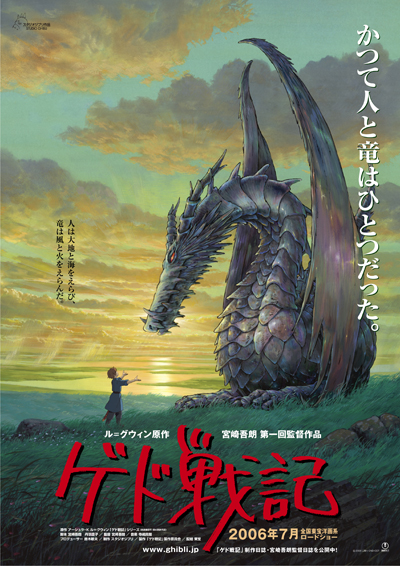
[新聞] <<地海傳說>>要以動畫呈現在大螢幕了!
- Sep 13 Tue 2005 02:05
-
NYTimes-Books of The Times; Medieval Mystery
- Sep 02 Fri 2005 23:41
-
NYTimes-THEATER REVIEW;Enter Singing: Young, Hopeful And Taking On The Big Time
Published: April 30, 1996
Two months, one Pulitzer Prize and acres of magazine and newspaper pages later, the waiflike hopes of the American musical are living in fancier digs. Uprooted by a cyclone of critical ecstasy and a hunger for theatrical novelty, they have posed for fashion layouts, inspired a Bloomingdale's ad campaign and will record their songs about life on the edge for David Geffen's Dreamworks label. They even have a producer who is comparing their spirit to that of -- oh, dear -- the movie "Forrest Gump." "Rent," Jonathan Larson's luminous, youthful musical that started off at the tiny New York Theater Workshop on East Fourth Street in February, opened on Broadway last night at the Nederlander Theater, after previews that drew such paparazzis' dreams as Billy Joel, David Bowie and Ralph Fiennes. And, no, Toto, I don't think we're in the East Village anymore. Everyone can breathe one quick sigh of relief, however, before lamenting the way of all flash. Anyone who loved "Rent" in its first incarnation is not going to feel like the victim of a Champagne hangover who wakes up next to a creepy stranger.